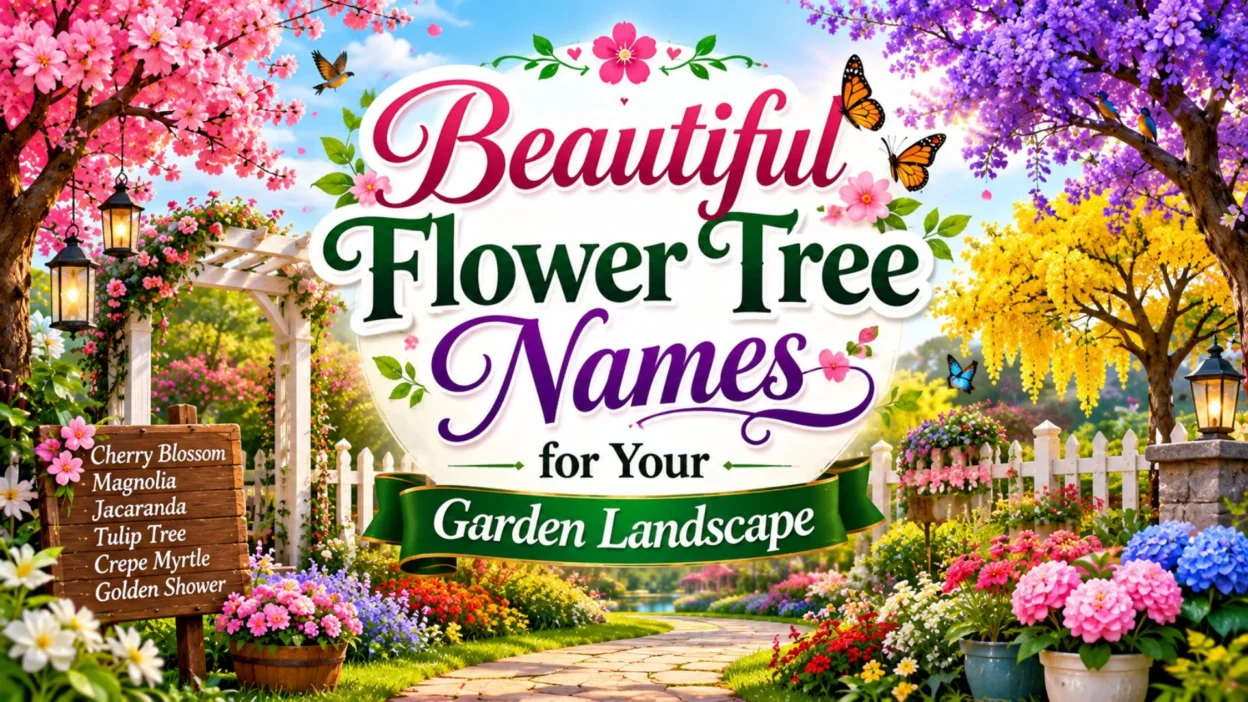
Flower tree names bring together the majesty of trees with the delicate beauty of blossoms. Whether you are designing a garden, writing a story, or simply love nature, knowing these names helps you identify and appreciate the flowering trees around you. Many people search for flower tree names when planning their landscaping projects or when they spot a beautiful bloom and want to know what tree produced it.
Flowering trees transform ordinary spaces into magical landscapes. From the soft pink of cherry blossoms to the bright white of dogwood flowers, each tree offers something unique. Learning these names also helps you choose the right tree for your climate and soil type. Some flower trees bloom in early spring while others wait for summer heat. Understanding these differences makes you a better gardener and nature enthusiast.
What are the most popular flowering trees for home gardens?
The most popular flowering trees for home gardens include dogwood, crape myrtle, magnolia, redbud, and flowering cherry trees. These trees are loved because they are relatively easy to grow and produce stunning blooms each year. Dogwood trees offer white or pink flowers in spring. Crape myrtles bloom all summer long in hot climates. Magnolias produce huge, fragrant flowers that smell amazing. Redbuds have unique purple-pink flowers that grow directly on branches. Flowering cherry trees create spectacular spring displays that people travel miles to see.
Flower Tree Names That Start with A
Trees beginning with A offer some of the earliest spring blooms. These flowering trees are favorites in many gardens and public parks. Each one brings its own color and shape to the landscape.
- Acacia
- Apple
- Apricot
- Almond
- Amur Maple
- Angel Trumpet
- American Fringe
- Ashoka
- Australian Willow
- Avocado
- Azalea Tree
- Adams Crabapple
- African Tulip
- Alaska Cedar
- Albizia
- Alder Buckthorn
- Almond Verbena
- Alpine Current
- Amelanchier
- American Holly
- American Plum
- Anise Tree
- Apple Berry
- Apricot Mallow
- Arbutus
- Arrowwood
- Ash Leaf Spirea
- Atemoya
- Atlas Cedar
- Austrian Briar
- Autumn Cherry
- Autumn Olive
- Avocado Pear
- Azara
- Azarole
- Arizona Rosewood
- Asian Pear
- Australian Tea
- Avalon Plum
- Aztec Lily
Flower Tree Names That Start with B
B trees bring bold colors and interesting shapes to any garden. Many of these flowering trees are known for their resilience and long blooming seasons. They work well in both small and large spaces.
- Bauhinia
- Bay Laurel
- Beauty Bush
- Beech
- Birch
- Black Locust
- Blackwood
- Bottlebrush
- Bougainvillea
- Box Elder
- Bradford Pear
- Brazilian Cherry
- Brittle Bush
- Broom Tree
- Buckeye
- Buddha Coconut
- Bunya Bunya
- Buttercup Tree
- Butterfly Tree
- Butternut
- Buttonbush
- Bower Tree
- Brachychiton
- Bramble Tree
- Brazilian Plume
- Breadfruit
- Bristlecone
- Broad Leaf Palm
- Broom Cypress
- Brush Cherry
- Buchu Tree
- Buckthorn
- Buffalo Thorn
- Bullet Tree
- Bunya Pine
- Burdock Tree
- Bur Oak
- Bush Banana
- Butterfly Bush
- Butterwood
Flower Tree Names That Start with C
C trees include some of the most beloved flowering trees in the world. Cherry blossoms and crabapples are famous for their spectacular spring shows. These trees are perfect for creating focal points in your yard.
- Cherry
- Crabapple
- Crape Myrtle
- Catalpa
- Camellia
- Carob
- Cassia
- Cedar
- Cercis
- Chaste Tree
- Chickasaw Plum
- Chilean Wine
- Chinar
- Chionanthus
- Chrysophyllum
- Cider Gum
- Cigar Tree
- Cinnamon
- Clematis Tree
- Cockspur Thorn
- Coffee Tree
- Cork Tree
- Cornelian Cherry
- Cottonwood
- Crabwood
- Crape Jasmine
- Crimson Bottlebrush
- Crown Wood
- Curry Leaf
- Custard Apple
- Cypress
- Cytisus
- Calabash
- California Lilac
- Camphor
- Candlenut
- Cannonball
- Carob Tree
- Carolina Silverbell
- Cedar Waxwing
Flower Tree Names That Start with D
D trees offer diversity in size, bloom color, and growing conditions. Some are large shade trees while others stay small enough for containers. These flowering trees add charm to any landscape.
- Dogwood
- Daisy Tree
- Daphne
- Date Plum
- Davidia
- Desert Willow
- Dombeya
- Dove Tree
- Dragon Tree
- Dwarf Apple
- Dwarf Cherry
- Dwarf Peach
- Dwarf Plum
- Dwarf Pomegranate
- Dombeya Wallichii
- Damask Rose Tree
- Daphniphyllum
- Darwin Barberry
- Date Palm
- Dawn Redwood
- Deciduous Holly
- Deodar Cedar
- Desert Cassia
- Desert Ironwood
- Devils Walking Stick
- Diamond Leaf
- Dillenia
- Diospyros
- Dipladenia
- Discaria
- Dodonaea
- Dovewood
- Drimys
- Dropwort Tree
- Drumstick
- Dryandra
- Duguetia
- Durian
- Dutch Elm
- Dwarf Mulberry
Flower Tree Names That Start with E
E trees include elegant specimens known for their evergreen leaves and long-lasting blooms. Many of these flowering trees are excellent choices for privacy screens or windbreaks while still offering beautiful flowers.
- Elderberry
- Elm
- Eucalyptus
- Euonymus
- Edgeworthia
- Elliottia
- Embothrium
- Empress Tree
- Enkianthus
- Ephedra
- Eranthemum
- Eriobotrya
- Erythrina
- Escallonia
- Eschscholzia
- Eucalyptus Caesia
- Eucryphia
- Eugenia
- Euodia
- Eupomatia
- Europaeus
- Evergreen Ash
- Evergreen Dogwood
- Evergreen Magnolia
- Evergreen Pear
- Exochorda
- Eye Tree
- Ezomatsu
- Ebony Tree
- Ecuador Laurel
- Edelweiss Tree
- Ekberg Apple
- Elaeagnus
- Elaeocarpus
- Elderflower
- Elephant Apple
- Eleutherococcus
- Elmleaf Blackberry
- Emu Tree
- English Hawthorn
Flower Tree Names That Start with F
F trees bring fragrance and delicate blooms to gardens worldwide. Many of these flowering trees are prized for their sweet scents that fill the air during bloom season. They attract pollinators and delight visitors.
- Fringe Tree
- Fuchsia
- Ficus
- Fir
- Franklinia
- Fraxinus
- Fremontodendron
- Fuchsia Flowering
- Ficus Carica
- Fiddlewood
- Fig Tree
- Firethorn
- Fir Tree
- Flame Tree
- Flannel Bush
- Flax Lily
- Flowering Ash
- Flowering Currant
- Flowering Dogwood
- Flowing Maple
- Flowering Quince
- Flowering Shrub
- Fool’s Gold
- Forest Pansy
- Forget Me Not
- Formosa Lily
- Fothergilla
- Fountain Tree
- Four O Clock
- Foxtail Palm
- Frankincense
- Fringe Myrtle
- Fringe Flower
- Frostweed
- Fruit Salad
- Fuchsia Regia
- Fukien Tea
- Full Moon Maple
- Fuzzy Tree
- Fynbos Tree
Flower Tree Names That Start with G
G trees offer unique flowers that stand out in any garden. Many gardeners seek out these flowering trees for their unusual bloom shapes and vibrant colors. They become conversation pieces in any landscape.
- Gardenia
- Golden Rain
- Ginkgo
- Grevillea
- Gleditsia
- Gordonia
- Gorse
- Goumi
- Grape Myrtle
- Grass Tree
- Greengage
- Grewia
- Greyia
- Grewia Asiatica
- Groundsel Tree
- Grumichama
- Guava
- Guayacan
- Gumbo Limbo
- Gum Tree
- Gurjun
- Gymnosporia
- Gynandropsis
- Gynura
- Gypsophila
- Gabon Ebony
- Galactia
- Galphimia
- Gamboge
- Garcinia
- Garden Rose
- Garland Flower
- Garrya
- Gaultheria
- Gaylussacia
- Genista
- Gentian Tree
- Geoffroea
- Geum
- Ghost Tree
Flower Tree Names That Start with H
H trees are known for their hardy nature and reliable blooms. These flowering trees can tolerate a range of conditions while still producing beautiful flowers year after year. They are excellent choices for beginner gardeners.
- Hawthorn
- Hibiscus
- Holly
- Hornbeam
- Honeysuckle
- Hop Tree
- Horse Chestnut
- Hortensia
- Hovenia
- Huckleberry
- Hudsonia
- Hugonia
- Hummingbird Tree
- Hundred Fruit
- Hunteria
- Hura
- Hutchinsia
- Hyacinth Tree
- Hydrangea
- Hymenaea
- Hymenosporum
- Hypericum
- Hypocalymma
- Hackberry
- Hairy Flower
- Hakea
- Halimodendron
- Halleria
- Hamamelis
- Handroanthus
- Hardy Rubber
- Harlequin Glory
- Hau Tree
- Hawaiian Tree
- Hawkweed
- Heartleaf
- Heather Tree
- Hedge Maple
- Helia
- Heliconia
Flower Tree Names That Start with I
I trees include some unfamiliar flowering trees that catch the eye immediately. These trees often have large, dramatic flowers or unusual blooming habits. They add a tropical feel to any garden setting.
- Incense Cedar
- Indian Bean
- Indian Coral
- Indian Plum
- Indian Rose
- Inga
- Iochroma
- Ipil
- Ipomoea
- Irenodendron
- Iresine
- Iron Tree
- Ironwood
- Island Oak
- Ita Palm
- Italian Alder
- Italian Cypress
- Italian Plum
- Itea
- Iva
- Ixora
- Ice Cream Bean
- Idesia
- Ilex
- Illawarra Flame
- Ilomba
- Illicium
- Impatiens Tree
- Indian Almond
- Indian Beech
- Indian Hawthorne
- Indian Laburnum
- Indian Mulberry
- Indian Olive
- Indian Senna
- Indian Tulip
- Inga Bean
- Ink Berry
- Ink Nut
- Inkwood
Flower Tree Names That Start with J
J trees offer bright blooms that stand out against green foliage. These flowering trees are favorites among gardeners who want high-impact color in their landscapes. They bloom at various times throughout the growing season.
- Jacaranda
- Jasmine
- Jujube
- Java Plum
- Jaboticaba
- Jackfruit
- Jamaican Cap
- Japanese Cherry
- Japanese Maple
- Japanese Pagoda
- Japanese Plum
- Japanese Snowball
- Japanese Stewartia
- Jasmine Tree
- Jatropha
- Jelly Palm
- Jerusalem Thorn
- Jessamine
- Jew Plum
- Jimson Weed
- Jiqui
- Jobos
- Johannesia
- Johnny Berry
- Jojoba
- Jolie Fleur
- Jonesia
- Josephs Coat
- Jubaea
- Judas Tree
- Jujube Date
- Julbernardia
- Jumeirah
- Jumping Bean
- Juniper
- Juniper Berry
- Juniper Tree
- Junkin Tree
- Jupiter Tree
- Jutia
Flower Tree Names That Start with K
K trees include both familiar favorites and rare gems. These flowering trees bring unique beauty to gardens around the world. Many have cultural significance in their native regions.
- Kalmia
- Kapok
- Katsura
- Kauri
- Kawakawa
- Kei Apple
- Kentia Palm
- Kentucky Coffee
- Key Lime
- Khadira
- Khaya
- Kielmeyera
- Kilhi
- King Coconut
- King Protea
- Kino Tree
- Kiwi Fruit
- Koa
- Koelreuteria
- Kohuhu
- Kokum
- Kolea
- Kolomikta
- Kompassia
- Kona Palm
- Kopsia
- Korean Cherry
- Korean Dogwood
- Korean Fir
- Korean Maple
- Korean Stewartia
- Koroi
- Kou
- Kowhai
- Kraunhia
- Kumquat
- Kurrajong
- Kusu Tree
- Kutjera
- Kwai Muk
Caring for Your Flowering Trees Throughout the Year
Flowering trees need different care depending on the season. In spring, focus on removing dead branches and applying fresh mulch around the base. Summer requires regular watering, especially for young trees and during dry spells. Deep watering encourages roots to grow downward where they find more moisture. Fall is the best time to plant new flowering trees because the soil is still warm but the air is cool. Winter care involves protecting tender trees from frost and checking for damage after storms. Regular pruning after blooming helps maintain shape and encourages more flowers next year.
Common Problems When Growing Flowering Trees
Many gardeners face challenges when growing flowering trees. Poor soil drainage causes root rot, which slowly kills the tree. Choose a planting spot where water does not pool after rain. Pests like aphids and scale insects suck sap from leaves and branches. You can control most pests with insecticidal soap or neem oil applied according to package directions. Fungal diseases often appear when leaves stay wet for too long. Water your flowering trees at the base rather than from above. Nutrient deficiencies show up as yellow leaves or poor bloom production. A balanced fertilizer applied in early spring usually solves this problem.
How to Choose the Right Flowering Tree for Your Space
Selecting the perfect flowering tree starts with measuring your available space. Small yards need compact trees that stay under twenty feet tall. Large properties can accommodate majestic specimens that grow fifty feet or more. Consider how much sunlight your planting area receives each day. Most flowering trees need at least six hours of direct sun to bloom well. Check your hardiness zone before buying any tree. A tree that grows beautifully in Florida will likely die in Minnesota. Think about bloom time too. Some trees flower for only two weeks while others bloom for months. Planting multiple trees with different bloom times gives you flowers all season long.
Best Flowering Trees for Small Gardens
Small gardens require trees that stay compact without overwhelming the space. Dwarf flowering cherry trees reach only ten feet tall at maturity. They produce the same beautiful pink blooms as their larger cousins. Crape myrtle varieties like Tonto and Acoma stay under twelve feet. These trees bloom all summer in hot climates. Japanese maples offer stunning foliage color even when not in flower. Their delicate leaves turn brilliant red and orange each fall. Dogwood trees fit perfectly in small urban yards. They grow slowly and rarely exceed fifteen feet. Redbud trees have a natural spreading shape that looks graceful without taking over. Their purple-pink flowers appear directly on branches in early spring.
Flowering Trees That Attract Pollinators
Pollinators love flowering trees that produce plenty of nectar and pollen. Bees especially favor fruit trees like apple, cherry, and plum. These trees bloom early in spring when bees need food most. Butterflies flock to buddleia trees, which are sometimes called butterfly bushes. The long flower clusters provide an easy landing pad for delicate wings. Hummingbirds cannot resist tubular flowers on trees like coral bean or silk floss. These bright red and orange blooms match the birds favorite colors. Native flowering trees often support more pollinators than unfamiliar varieties. Consider planting serviceberry, hawthorn, or black locust to help local bees and butterflies thrive.
When to Prune Different Flowering Trees
Pruning at the wrong time can remove flower buds before they open. Spring flowering trees like dogwood and redbud set their flower buds the previous summer. Prune these trees right after they finish blooming in spring. Summer flowering trees like crape myrtle and golden rain produce flowers on new growth. You can prune these trees in late winter or early spring before new growth begins. Never remove more than one quarter of a tree’s branches in a single year. Make clean cuts just outside the branch collar where the branch meets the trunk. Remove dead, damaged, or crossing branches whenever you see them. Good pruning keeps your flowering trees healthy and full of blooms.
FAQs
What is the most beautiful flowering tree?
Many people consider the cherry blossom tree the most beautiful flowering tree. Its delicate pink and white flowers create spectacular displays each spring. The jacaranda tree with its purple blooms is another top contender for beauty.
Which flowering tree blooms the longest?
Crape myrtle trees bloom for up to four months in warm climates. They start flowering in early summer and continue until the first fall frost. Some modern hybrids bloom even longer than traditional varieties.
What flowering tree grows fastest?
The empress tree or princess tree grows up to fifteen feet per year. It produces large, fragrant purple flowers in spring before leaves appear. This tree reaches full size in just a few years.
Can flowering trees grow in pots?
Yes, many dwarf flowering trees grow well in large containers. Choose compact varieties of Japanese maple, flowering cherry, or crape myrtle. Use a pot at least eighteen inches wide with drainage holes.
What flowering tree requires the least maintenance?
The eastern redbud tree needs very little care once established. It tolerates both sun and partial shade. It rarely suffers from serious pests or diseases.
When should I plant a new flowering tree?
Plant flowering trees in early spring or fall when temperatures are mild. Avoid planting during summer heat or winter freezes. Fall planting gives roots time to establish before spring growth begins.
Conclusion
Flower tree names open up a world of beauty and possibility for your garden. Whether you choose a classic dogwood or an unfamiliar jacaranda, flowering trees bring joy for generations. Use this guide to find the perfect trees for your climate and space. Remember to consider mature size, bloom time, and sunlight needs before planting. With proper care, your flowering trees will reward you with breathtaking blooms every year.

James Anderson is a passionate floral writer and lifestyle content creator with a love for nature, creativity, and meaningful moments. With a keen eye for beauty and detail, he shares insights on flowers, gifting ideas, floral trends, and special occasion inspiration. Through Florenzay, James aims to help people express emotions and create unforgettable memories through the timeless charm of flowers. 🌸