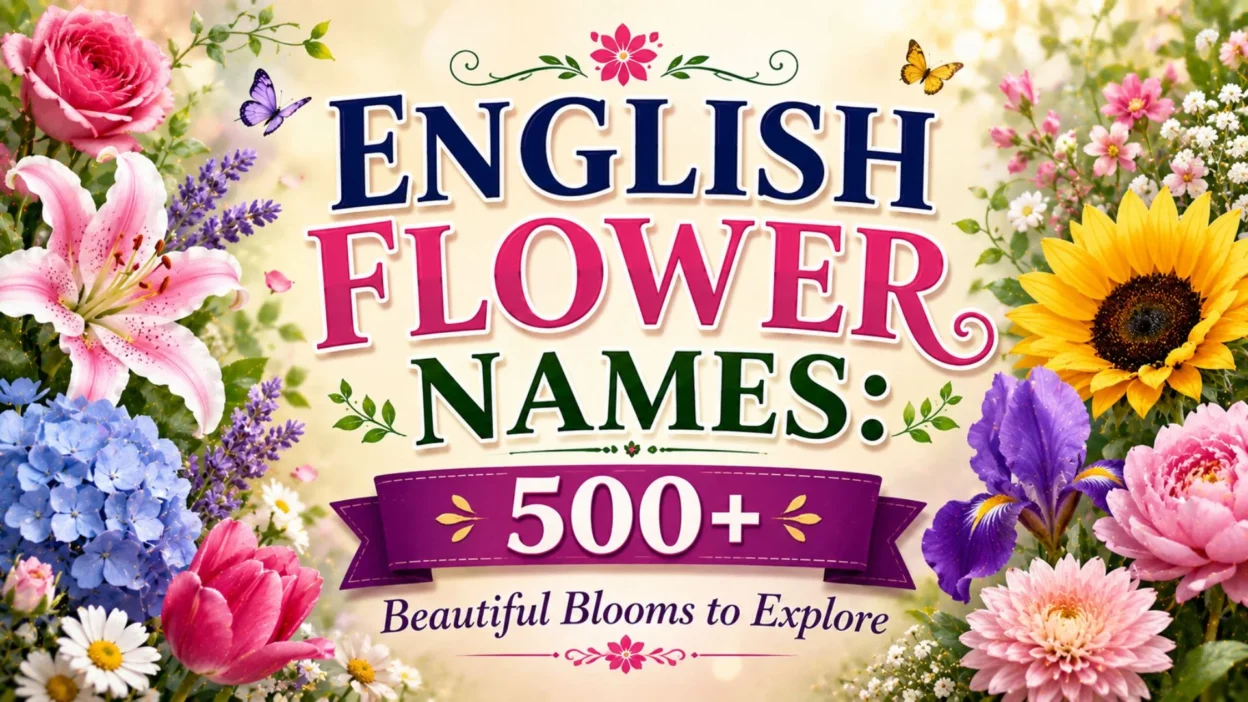
English flower names open the door to a colorful world of gardens, meadows, bouquets, and botanical beauty. From familiar roses and tulips to delicate bluebells and unusual foxgloves, flower names can describe appearance, fragrance, season, habitat, and even cultural meaning. Whether you are naming a garden, creating a floral-themed project, choosing baby name inspiration, or simply learning more about plants, this collection gives you plenty of ideas. It brings together classic blooms, wildflowers, fragrant flowers, cottage garden favorites, tropical varieties, and elegant botanical names. You will also find familiar common names alongside less common choices that can make your list feel fresh and distinctive.
This guide organizes English flower names into easy-to-browse groups so you can quickly find the right bloom. Some names sound soft and romantic, while others feel bold, cheerful, mysterious, or graceful. Many also connect with colors, seasons, nature, and traditional gardens. As you explore the lists, consider how each flower looks and where it naturally grows. You can use these names for garden planning, creative writing, floral designs, educational projects, or name inspiration. The goal is simple: help you discover beautiful flower names without making the search complicated. From spring flowers to summer blossoms and woodland plants, there is something here for almost every floral taste.
Which English flower names are easiest to recognize?
English flower names such as Rose, Daisy, Lily, Tulip, Violet, and Sunflower are among the most familiar choices.
They are easy to remember because people commonly see them in gardens, bouquets, parks, and nature.
More unusual names include Columbine, Snapdragon, Foxglove, Primrose, and Sweet Pea.
This guide includes both familiar flowers and distinctive botanical choices for broader inspiration.
English Flower Names for Classic Garden Blooms
Classic flowers have timeless names that work beautifully in gardens and floral arrangements. These familiar blooms often bring traditional charm and recognizable colors to any collection.
- Rose
- Lily
- Daisy
- Tulip
- Violet
- Iris
- Peony
- Poppy
- Carnation
- Dahlia
- Begonia
- Petunia
- Geranium
- Marigold
- Zinnia
- Cosmos
- Aster
- Chrysanthemum
- Primrose
- Snapdragon
- Foxglove
- Hollyhock
- Delphinium
- Gladiolus
- Hydrangea
- Gardenia
- Camellia
- Magnolia
- Azalea
- Rhododendron
- Begonia
- Freesia
- Daffodil
- Narcissus
- Hyacinth
Beautiful English Flower Names Inspired by Spring
Spring flowers bring fresh color after winter and often signal renewal, warmth, and new growth. Their names suit anyone looking for cheerful and uplifting floral inspiration.
- Bluebell
- Crocus
- Snowdrop
- Daffodil
- Tulip
- Hyacinth
- Primrose
- Cowslip
- Wallflower
- Anemone
- Forsythia
- Lily of the Valley
- Sweet Pea
- Pansy
- Violet
- Columbine
- Bleeding Heart
- Pasque Flower
- Lungwort
- Starflower
- Windflower
- Buttercup
- Wood Anemone
- Spring Beauty
- Trillium
- Siberian Squill
- Winter Aconite
- Grape Hyacinth
- Flowering Almond
- Flowering Quince
- Candytuft
- Rock Cress
- Hellebore
- Virginia Bluebell
- Dutchman’s Breeches
English Flower Names for Fragrant and Sweet Blooms
Fragrant flowers add another layer of beauty because their names often remind people of gardens, perfumes, and warm evenings. These choices are especially appealing for sensory or romantic themes.
- Lavender
- Jasmine
- Gardenia
- Honeysuckle
- Rose
- Sweet Pea
- Freesia
- Lilac
- Hyacinth
- Tuberose
- Violet
- Lily
- Stock
- Sweet William
- Daphne
- Mock Orange
- Wisteria
- Heliotrope
- Osmanthus
- Nicotiana
- Night Blooming Jasmine
- Scented Geranium
- Angel’s Trumpet
- Orange Blossom
- Star Jasmine
- Confederate Jasmine
- Stephanotis
- Dianthus
- Carnation
- Sweet Alyssum
- Mignonette
- Moonflower
- Four O’Clock
- Lemon Verbena
- Bee Balm
English Flower Names for Colorful Summer Flowers
Summer gardens are filled with bold shades, bright petals, and long-lasting blooms. These English flower names capture the lively character of flowers that thrive during sunny months.
- Sunflower
- Coneflower
- Black Eyed Susan
- Coreopsis
- Cosmos
- Zinnia
- Dahlia
- Daylily
- Bee Balm
- Yarrow
- Phlox
- Verbena
- Lantana
- Portulaca
- Celosia
- Cleome
- Impatiens
- Petunia
- Salvia
- Lobelia
- Geranium
- Globe Amaranth
- Blanket Flower
- Joe Pye Weed
- Ironweed
- Goldenrod
- Queen Anne’s Lace
- Borage
- Calendula
- Cornflower
- Nasturtium
- Morning Glory
- Mexican Sunflower
- African Daisy
- Globe Thistle
English Flower Names for Woodland and Wild Flowers
Woodland flowers often have gentle names connected with forests, shade, streams, and natural landscapes. They bring a quiet and storybook quality to floral collections.
- Bluebell
- Wood Anemone
- Primrose
- Foxglove
- Columbine
- Lungwort
- Celandine
- Wood Sorrel
- Wild Garlic
- Wild Strawberry
- Wild Violet
- Dog Violet
- Red Campion
- White Campion
- Sweet Cicely
- Meadow Rue
- Wood Avens
- Herb Robert
- Harebell
- Cow Parsley
- Wild Angelica
- Meadowsweet
- Lady’s Mantle
- Solomon’s Seal
- Toadflax
- Self Heal
- Greater Stitchwort
- Ragged Robin
- Bugle
- Betony
- Woodruff
- Sanicle
- Germander Speedwell
- Bird’s Foot Trefoil
- Wild Marjoram
English Flower Names for Elegant and Romantic Blooms
Some flowers naturally feel graceful and romantic because of their delicate shapes, soft colors, and long history in bouquets. These names can inspire wedding themes, garden designs, and poetic projects.
- Rose
- Peony
- Camellia
- Gardenia
- Magnolia
- Ranunculus
- Anemone
- Freesia
- Lisianthus
- Garden Rose
- English Rose
- Sweet Pea
- Hydrangea
- Dahlia
- Carnation
- Violet
- Lily
- Iris
- Primrose
- Clematis
- Wisteria
- Lilac
- Forget Me Not
- Baby’s Breath
- Queen Anne’s Lace
- Delphinium
- Stock
- Larkspur
- Amaranth
- Cosmos
- Verbena
- Honeysuckle
- Nasturtium
- Morning Glory
- Bleeding Heart
English Flower Names for White and Pale Blooms
White flowers create a clean, peaceful appearance and often symbolize simplicity, purity, or elegance. Pale blossoms also work beautifully when you want a soft and understated floral theme.
- White Rose
- White Lily
- White Tulip
- White Peony
- White Daisy
- White Carnation
- White Camellia
- White Gardenia
- White Iris
- White Hydrangea
- White Dahlia
- White Zinnia
- White Cosmos
- White Poppy
- White Foxglove
- White Snapdragon
- White Primrose
- White Freesia
- White Anemone
- White Hyacinth
- White Clover
- White Clover Flower
- White Clover Blossom
- White Lilac
- White Hollyhock
- White Delphinium
- White Columbine
- White Bellflower
- White Campion
- White Sweet Pea
- White Yarrow
- White Phlox
- White Verbena
- White Jasmine
- White Honeysuckle
English Flower Names for Blue and Purple Blossoms
Blue and purple flowers bring cool, dreamy colors to gardens and bouquets. Their names often feel mysterious, calming, or magical, making them popular for creative projects.
- Bluebell
- Blue Iris
- Blue Poppy
- Blue Lupine
- Blue Delphinium
- Blue Hydrangea
- Blue Salvia
- Blue Cornflower
- Blue Flax
- Blue Star Flower
- Blue Forget Me Not
- Blue Veronica
- Bluebell Creeper
- Purple Iris
- Purple Coneflower
- Purple Loosestrife
- Purple Verbena
- Purple Clematis
- Purple Aster
- Purple Dahlia
- Purple Petunia
- Purple Pansy
- Purple Hyacinth
- Purple Crocus
- Purple Columbine
- Purple Larkspur
- Purple Stock
- Purple Phlox
- Purple Allium
- Purple Sage
- Purple Toadflax
- Purple Passionflower
- Purple Morning Glory
- Purple Vetch
- Purple Bellflower
English Flower Names for Yellow and Golden Flowers
Yellow flowers are natural symbols of sunshine, optimism, and cheerful energy. This group includes familiar garden favorites as well as wildflowers with warm golden tones.
- Sunflower
- Daffodil
- Buttercup
- Marigold
- Coreopsis
- Goldenrod
- Black Eyed Susan
- Yellow Rose
- Yellow Lily
- Yellow Tulip
- Yellow Iris
- Yellow Poppy
- Yellow Peony
- Yellow Dahlia
- Yellow Zinnia
- Yellow Cosmos
- Yellow Snapdragon
- Yellow Primrose
- Yellow Columbine
- Yellow Daylily
- Yellow Coneflower
- Yellow Lupine
- Yellow Yarrow
- Yellow Phlox
- Yellow Nasturtium
- Yellow Crocus
- Yellow Hyacinth
- Yellow Honeysuckle
- Yellow Jasmine
- Yellow Bells
- Golden Poppy
- Golden Aster
- Golden Ragwort
- Golden Clematis
- Golden Trumpet
English Flower Names for Pink and Red Blooms
Pink and red flowers bring warmth, passion, sweetness, and visual drama. Their names range from soft pastel blossoms to vivid garden flowers that naturally attract attention.
- Pink Rose
- Red Rose
- Pink Lily
- Red Lily
- Pink Tulip
- Red Tulip
- Pink Peony
- Red Peony
- Pink Carnation
- Red Carnation
- Pink Dahlia
- Red Dahlia
- Pink Zinnia
- Red Zinnia
- Pink Poppy
- Red Poppy
- Pink Geranium
- Red Geranium
- Pink Begonia
- Red Begonia
- Pink Hydrangea
- Red Hydrangea
- Pink Cosmos
- Pink Snapdragon
- Red Snapdragon
- Pink Camellia
- Red Camellia
- Pink Azalea
- Red Azalea
- Pink Dianthus
- Red Dianthus
- Pink Phlox
- Red Phlox
- Pink Hollyhock
- Red Hollyhock
English Flower Names for Cottage Garden Favorites
Cottage gardens combine relaxed planting with old-fashioned charm. Their flowers often appear naturally clustered around paths, fences, borders, and traditional country homes.
- Hollyhock
- Foxglove
- Delphinium
- Larkspur
- Sweet Pea
- Lavender
- Rose
- Peony
- Lupine
- Columbine
- Primrose
- Poppy
- Daisy
- Cosmos
- Cornflower
- Nasturtium
- Calendula
- Sweet William
- Dianthus
- Phlox
- Bee Balm
- Yarrow
- Lady’s Mantle
- Catmint
- Coreopsis
- Verbena
- Clematis
- Honeysuckle
- Wisteria
- Morning Glory
- Helenium
- Gaura
- Penstemon
- Scabiosa
- Valerian
English Flower Names for Wildflower Meadows
Wildflowers create a natural appearance and often thrive without the formal structure of traditional garden beds. Their common names can sound wonderfully rustic, cheerful, and memorable.
- Cornflower
- Poppy
- Oxeye Daisy
- Buttercup
- Red Clover
- White Clover
- Bird’s Foot Trefoil
- Cow Parsley
- Meadowsweet
- Queen Anne’s Lace
- Yarrow
- Chicory
- Harebell
- Red Campion
- White Campion
- Field Scabious
- Wild Carrot
- Wild Marjoram
- Wild Thyme
- Wild Basil
- Self Heal
- Cowslip
- Primrose
- Bluebell
- Vetch
- Knapweed
- Ragged Robin
- Greater Knapweed
- Common Sorrel
- Field Speedwell
- Corn Marigold
- Corn Cockle
- Corn Chamomile
- Wild Mignonette
- Wild Pansy
English Flower Names for Unusual and Rare-Looking Blooms
Unusual flowers can make a collection feel distinctive and memorable. These names include striking shapes, uncommon garden choices, and blooms that naturally attract curiosity.
- Bat Flower
- Black Bat Flower
- Bleeding Heart
- Dutchman’s Pipe
- Parrot Tulip
- Black Rose
- Chocolate Cosmos
- Monkey Face Orchid
- Bee Orchid
- Lady’s Slipper
- Ghost Orchid
- Queen of the Night
- Corpse Flower
- Passionflower
- Bird of Paradise
- Crown Imperial
- Love Lies Bleeding
- Angel’s Trumpet
- Dragon Flower
- Toad Lily
- Black Hollyhock
- Black Petunia
- Blue Poppy
- Himalayan Poppy
- Chocolate Lily
- Snake’s Head Fritillary
- Fairy Slipper
- Shooting Star
- Naked Lady
- Queen’s Cup
- Jack in the Pulpit
- Dutchman’s Breeches
- Jack in the Box
- Elephant Head
- Parrot Flower
English Flower Names for Flowers with Nature Inspired Meanings
Flowers often connect with natural ideas such as sunlight, water, birds, stars, seasons, and woodland life. These names are useful when you want a floral collection with a stronger connection to nature.
- Sunflower
- Moonflower
- Starflower
- Morning Glory
- Evening Primrose
- Snowdrop
- Bluebell
- Honeysuckle
- Buttercup
- Foxglove
- Harebell
- Bird of Paradise
- Bird’s Foot Trefoil
- Bee Balm
- Bee Orchid
- Butterfly Weed
- Hummingbird Flower
- Cardinal Flower
- Jewelweed
- Fireweed
- Goldenrod
- Windflower
- Rain Lily
- Water Lily
- Lotus
- Marsh Marigold
- Sea Holly
- Sea Lavender
- Sea Pink
- Rock Rose
- Rock Cress
- Mountain Avens
- Alpine Aster
- Prairie Rose
- Prairie Clover
English Flower Names for Tropical and Exotic Blooms
Tropical flowers are known for dramatic shapes, rich colors, and unusual forms. These names can add an adventurous feel to a garden list, creative project, or botanical collection.
- Bird of Paradise
- Hibiscus
- Plumeria
- Bougainvillea
- Orchid
- Passionflower
- Heliconia
- Anthurium
- Protea
- Frangipani
- Ginger Lily
- Torch Ginger
- Canna Lily
- Angel’s Trumpet
- Mandevilla
- Ixora
- Gardenia
- Jasmine
- Tuberose
- Lotus
- Water Lily
- Ylang Ylang
- Night Blooming Jasmine
- Moonflower
- Morning Glory
- Crown Flower
- Flame Lily
- Torch Lily
- Glory Lily
- Golden Trumpet
- Blue Passionflower
- Red Ginger
- Turmeric Flower
- Coral Vine
- Mexican Sunflower
English Flower Names for Charming Floral Inspiration
The final group brings together names that feel especially pleasant, memorable, and versatile. These flowers can suit garden themes, writing projects, floral art, and many other creative uses.
- Daisy
- Rose
- Lily
- Violet
- Poppy
- Iris
- Peony
- Tulip
- Bluebell
- Lavender
- Primrose
- Marigold
- Sunflower
- Buttercup
- Foxglove
- Honeysuckle
- Sweet Pea
- Forget Me Not
- Morning Glory
- Moonflower
- Snowdrop
- Daffodil
- Crocus
- Cosmos
- Zinnia
- Dahlia
- Aster
- Pansy
- Petunia
- Magnolia
- Camellia
- Gardenia
- Lilac
- Wisteria
- Clematis
How to Choose the Right English Flower Names
Choosing a flower name becomes easier when you first decide what quality matters most. You might want a name based on color, season, fragrance, shape, habitat, or symbolism. For example, Sunflower suggests warmth and brightness, while Lavender feels calm and fragrant. Bluebell has a woodland character, whereas Magnolia sounds elegant and classic.
Consider the setting as well. A cottage garden may suit Roses, Foxgloves, Hollyhocks, and Sweet Peas. A wildflower theme could include Cornflowers, Poppies, Yarrow, and Buttercups. For a romantic collection, Peonies, Gardenias, Camellias, and Freesias may work better. Looking at the flower itself can also help. Petal shape, bloom size, foliage, and natural habitat often make a name easier to remember.
Why Flower Names Make Great Creative Inspiration
Flower names have a natural advantage because they already carry visual and emotional associations. A single name can suggest a color, scent, season, landscape, or mood. That makes floral vocabulary useful for writers, gardeners, designers, parents, artists, and anyone creating a nature-inspired project.
Common flower names also tend to be easy to pronounce and remember. Less familiar names can add personality when you want something distinctive. Combining both types gives you a balanced collection. You can choose a familiar flower for clarity or an unusual bloom for a more memorable impression. Botanical names can also add another layer when you want a scientific or educational angle.
How to Find More Flowers Beyond Common Names
A good way to expand your floral knowledge is to compare common names with botanical names. Plant labels, gardening references, herbariums, and local botanical gardens can help identify less familiar species. Regional guides are also useful because common flower names can vary between countries and communities.
Pay attention to seasonal availability when identifying flowers. Some blooms appear mainly in spring, while others peak during summer or autumn. Growing conditions matter too. Sunlight, soil, moisture, temperature, and hardiness can determine whether a flower grows successfully in a particular location. If you plan to plant something from this list, verify its growing requirements before buying seeds or plants.
Frequently Asked Questions About English Flower Names
What is the most popular English flower name?
Rose is one of the best-known flower names in English and has a long history in gardens and culture. Daisy, Lily, Violet, and Iris are also familiar choices.
Which English flower names sound elegant?
Names such as Magnolia, Camellia, Gardenia, Peony, Dahlia, and Freesia have an elegant and graceful sound. They also refer to attractive ornamental flowers.
Which flower names are associated with spring?
Bluebell, Daffodil, Crocus, Snowdrop, Primrose, Tulip, Hyacinth, and Lily of the Valley are strongly associated with spring. Their blooming periods can vary by region.
Which English flower names are good for gardens?
Roses, Marigolds, Zinnias, Dahlias, Lavender, Foxgloves, Hollyhocks, and Sweet Peas are popular garden choices. However, suitability depends on climate and growing conditions.
What flower names are inspired by nature?
Sunflower, Moonflower, Starflower, Bluebell, Snowdrop, Buttercup, Windflower, Rain Lily, Water Lily, and Mountain Avens all have strong nature connections.
Which flower names are uncommon?
Bat Flower, Chocolate Cosmos, Ghost Orchid, Snake’s Head Fritillary, Crown Imperial, Toad Lily, and Shooting Star are less familiar than classic choices. Their unusual appearance also makes them memorable.
Are common flower names different from botanical names?
Yes. A common name is the everyday name people use for a plant, while a botanical name provides a standardized scientific identification. One plant can also have several common names.
How can I learn more English flower names?
Start with a seasonal flower guide and learn names by color, habitat, or flower family. Visiting gardens and identifying local blooms can make the learning process easier and more enjoyable.
Conclusion
English flower names offer far more variety than the familiar Rose, Lily, and Daisy. This collection includes classic garden flowers, spring blooms, wildflowers, fragrant plants, tropical species, cottage garden favorites, and unusual choices. You can use these names for gardening inspiration, creative writing, educational projects, floral designs, or simple nature exploration. Start with the qualities you like most, such as color, fragrance, season, or symbolism. Then narrow your choices to flowers that match your purpose. Whether you prefer a timeless Rose or an unusual Bat Flower, there is a beautiful name waiting to be discovered.

James Anderson is a passionate floral writer and lifestyle content creator with a love for nature, creativity, and meaningful moments. With a keen eye for beauty and detail, he shares insights on flowers, gifting ideas, floral trends, and special occasion inspiration. Through Florenzay, James aims to help people express emotions and create unforgettable memories through the timeless charm of flowers. 🌸